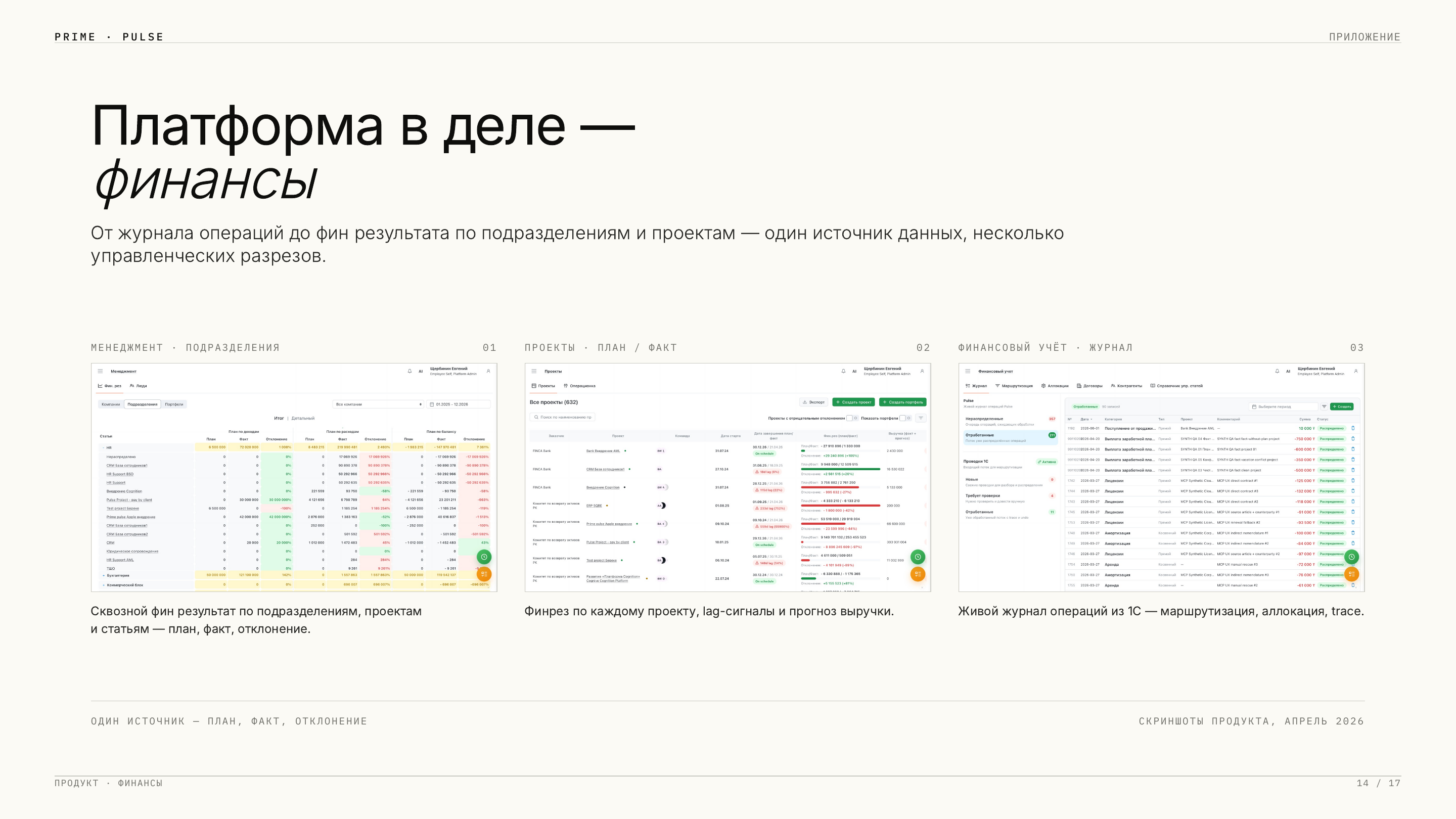
How Bridge CA helped the Pulse team package their internal financial-operational system into a commercial product, shape positioning through hundreds of custdev interviews, and close three enterprise contracts — including group-level licensing.
Pulse — a unified platform for managing project, product, and initiative economics — was originally built as a proprietary tool inside a major project-service enterprise. The platform provided an end-to-end data pipeline: tracking everything from employee timesheets and cost rates to project margins, with real-time financial reporting mapped across divisions, products, and cost centers. The internal team spent years perfecting it, allowing the CEO and CFO to make business-critical decisions instantly, rather than waiting months for accounting periods to close.
Once it became clear that this solution addressed a universal pain point, a new ambition emerged: **to package it as a commercial boxed offering** for other large-scale enterprises with complex project economics. However, a massive gap lay between "works for us" and "sells to the market" — *there was no product narrative, no standard packaging, no clear definition of the external buyer profile, and zero track record of enterprise sales outside their own corporate group.*
The traditional alternative was simple yet incredibly expensive: hire product leads, sales teams, and marketing experts, and spend 12 months burning capital before securing the first deal. The Pulse team sought a different path: **to validate their market hypotheses and close initial enterprise contracts before standing up a permanent sales function.**
Bridge CA took complete charge of **productization and sales**: transforming an internal system into a highly marketable enterprise solution, validating it through dozens of strategic C-level conversations, and driving the process to signed contracts. The scope was structured into three parallel workstreams.
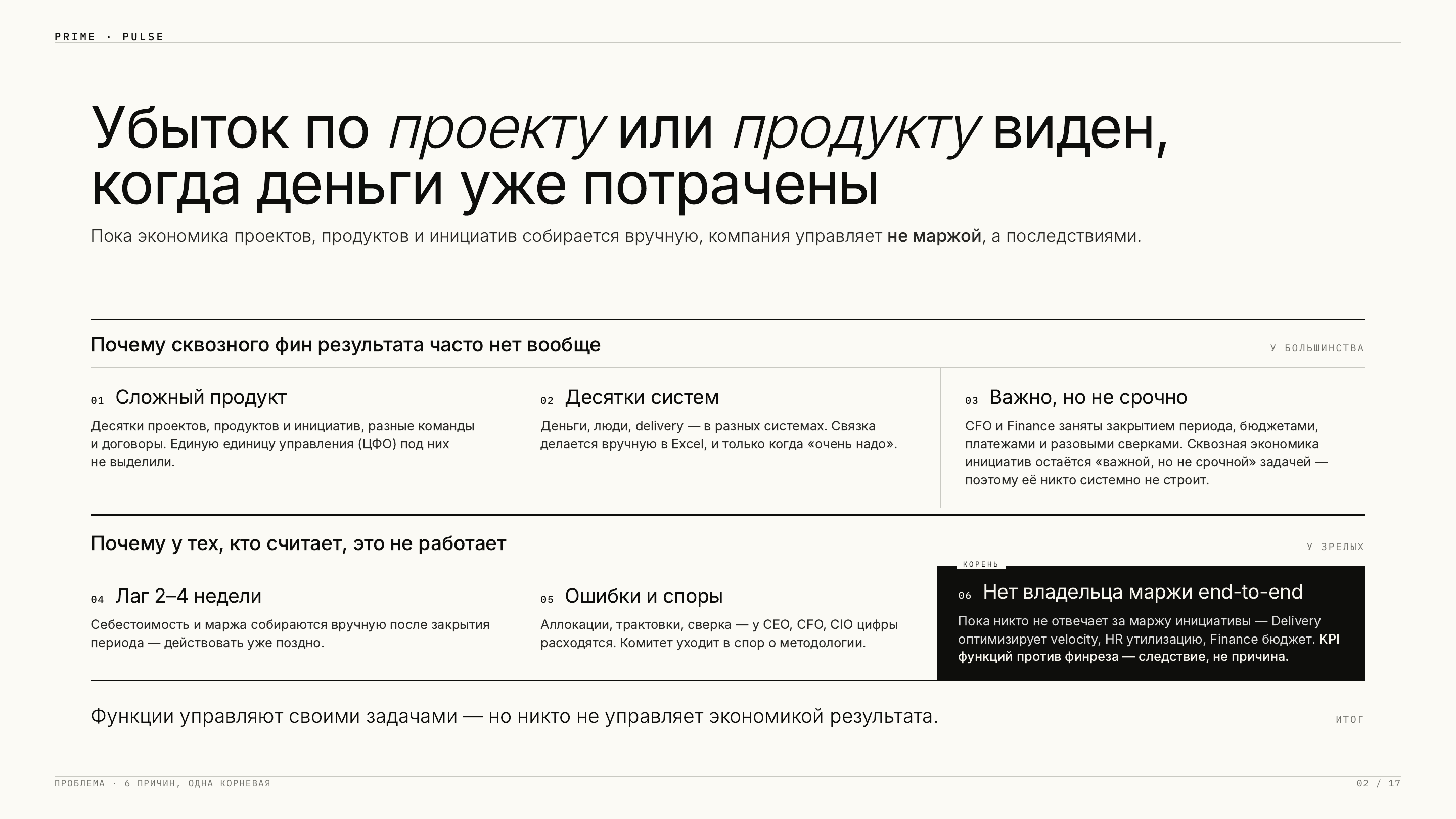
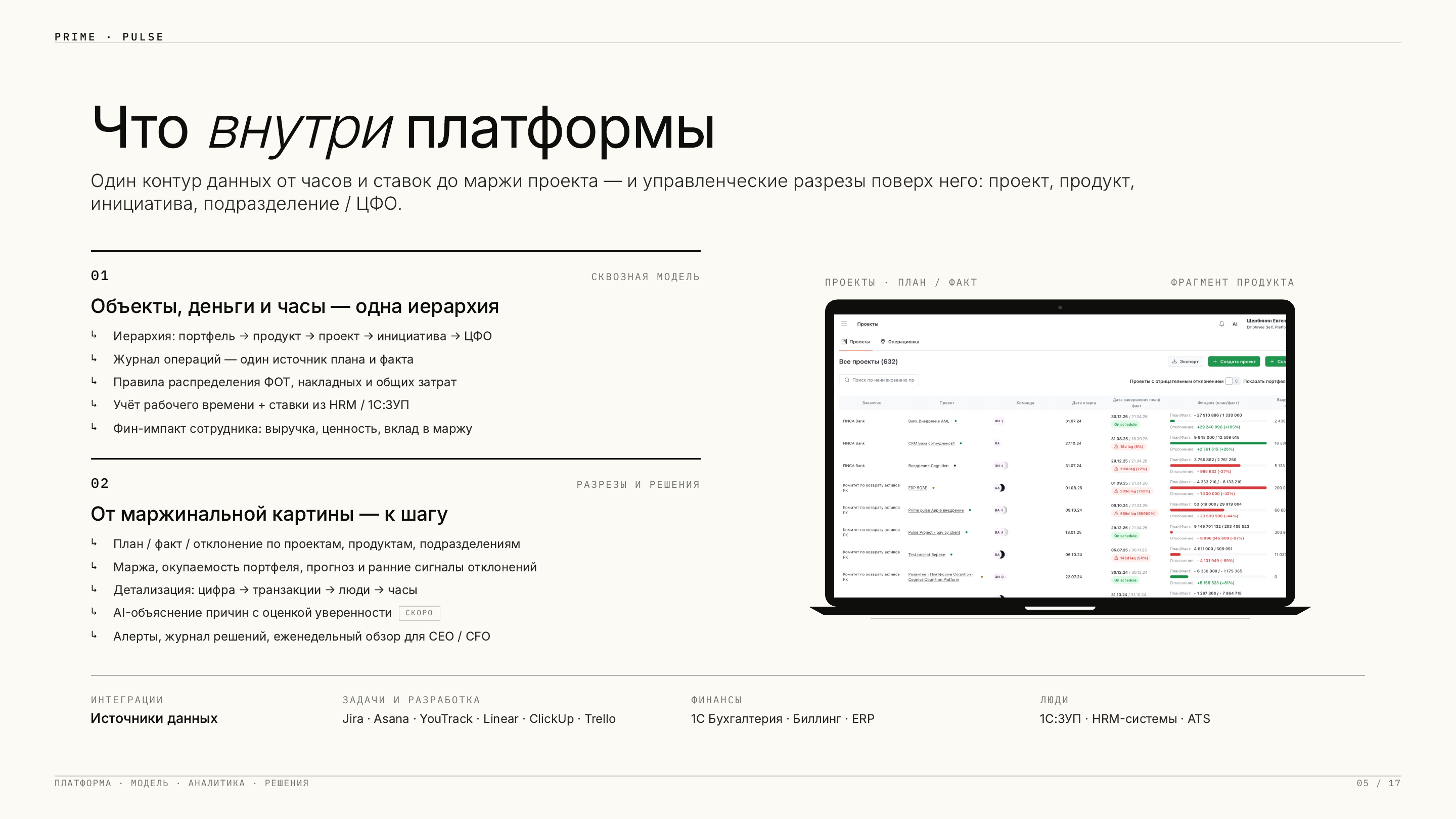
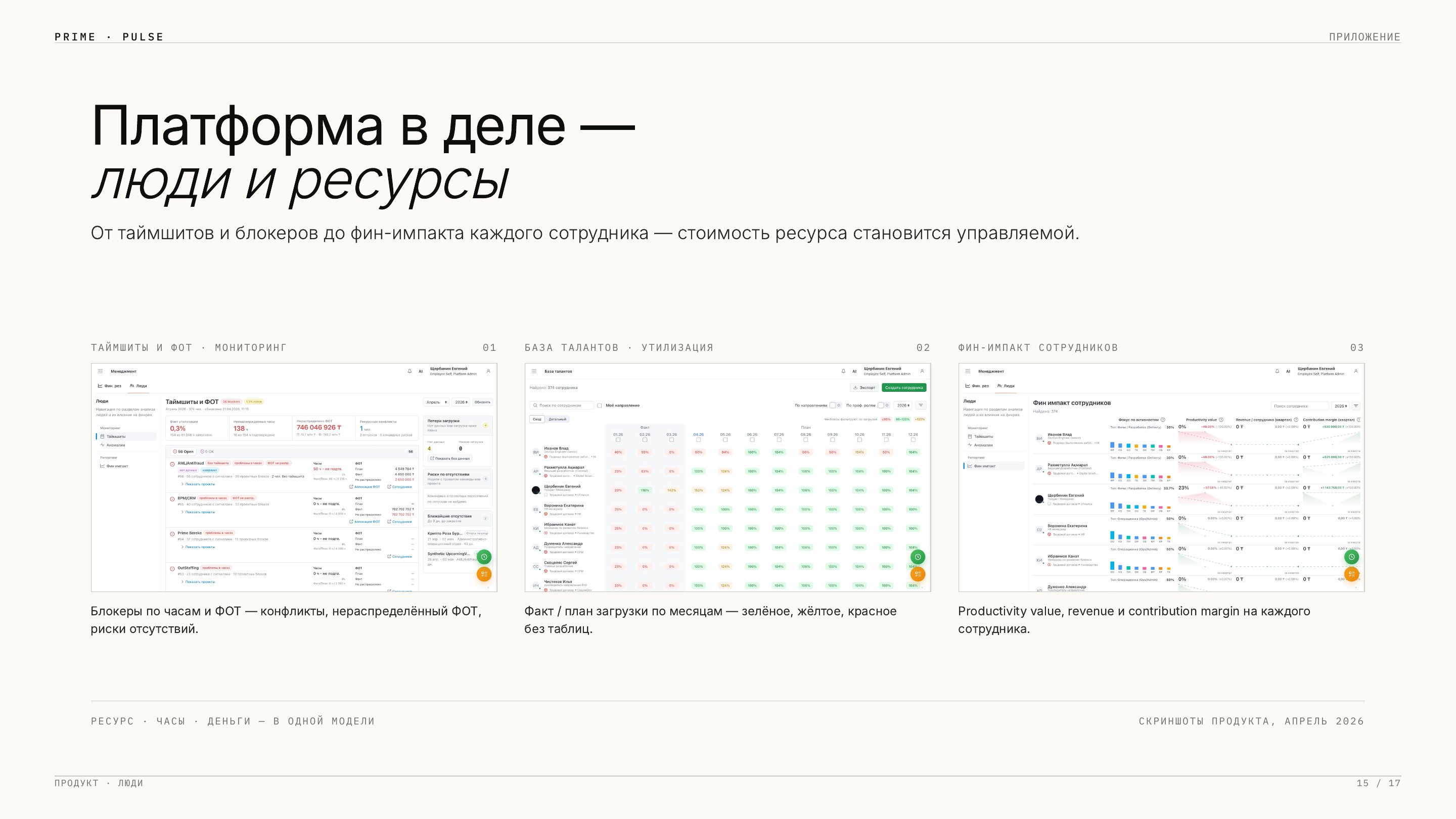
Our primary challenge was finding a single, powerful value thesis that could explain Pulse’s value in 30 seconds. After dozens of iterations, we arrived at: **"Stop playing catch-up with spreadsheets — manage your initiative economics in real-time."** This core narrative anchored all marketing assets: a comprehensive 17-slide enterprise sales deck, a concise one-pager for ecosystem hubs, and a high-converting marketing site at primepulse.ai.
Every slide in the product deck was engineered to address a specific pain point felt by a CFO or CEO — invisible project losses discovered only after budgets are fully spent, capital allocation decisions made without financial visibility, or delayed budget reallocations. Crucially, every section was backed by actual product screenshots rather than abstract wireframes.



In parallel with packaging, we initiated a high-velocity stream of customer development meetings with CEOs, CFOs, and CTOs at major conglomerates, banks, IT organizations, and project-service enterprises. Every conversation served a dual purpose: it validated our value hypotheses with real buyers while providing critical product calibration signals back to our development team.
A breakthrough observation emerged: enterprise buyers do not want to purchase another complex "software platform" outright. They need a **low-risk, highly structured first step**. In response, we designed the *Diagnostic Sprint*: a 10-day, fixed-price mapping of their cost centers, leading to a live pilot on a single initiative with initial financial visibility by T+30. This structured offer completely defused their main objection — the fear of long, open-ended IT implementation cycles.
The third track transitioned from strategic positioning directly to transactional execution. Leveraging Bridge CA's extensive relationship network, we secured direct access to executive decision-makers, framed negotiations around their core financial pain points, customized commercial proposals, presented business cases to executive boards, and managed the legal contracting process. In Central Asia, enterprise IT deals are closed not through ads or automated funnels, but through deep, trusted executive-level relationships.
A highly customized internal utility successfully evolved into a commercial product with a crystal-clear value proposition, verified market positioning, and real enterprise traction. During our engagement, the team closed **three high-profile contracts across distinct enterprise segments** — including a major IT holding, a digital telecom group, and a commercial bank.
Beyond immediate contract revenues, the Pulse team acquired what they lacked at kickoff: a highly repeatable **enterprise sales playbook**, a friction-free diagnostic sprint format, sales assets that close deals independently of the founders, and a strong portfolio of live reference accounts.
Crucially, our continuous customer development conversations yielded several core strategic insights that reshaped both the product roadmap and the sales approach:
For Bridge CA, this case study validates a core operating principle: a strong, proprietary internal tool can be successfully spun out into a commercial product without a massive up-front sales team hire — provided you construct the right value narrative and establish trusted, direct executive access. For Pulse, it represents their evolution from a private internal tool into a robust product with a growing portfolio of enterprise deployments.
Bridge CA's partners led the project hands-on: shaping the product narrative, sales assets, and operational positioning on one side, and driving the enterprise sales pipeline and deal execution on the other.

15+ years in fintech and startup operations. Specializes in transforming MVPs into enterprise-grade products, structuring commercial offerings, and scaling operations. For Pulse, he designed the core value narrative, structured the sales deck, one-pager, website, and established the "sprint + pilot" sales motion.

17+ years in enterprise software sales at SAP, Microsoft, and Salesforce. Architect of large-scale B2B transactions across the CIS and EMEA regions. For Pulse, he structured the enterprise pipeline, secured direct access to CEOs and CFOs of three major conglomerates, and managed the deal-closing process.
Bridge CA specializes in market-entry and product spin-out initiatives for B2B Enterprise IT companies expanding into Central Asia. If you have an internal corporate tool ready to be spun out into a standalone commercial business, get in touch.
Tell us about your product — let's discuss if there is market demand outside your organization, and how to reach the right enterprise buyers.
Start a conversation →